The context
That manufacturer creates value in the product and captures little of it. The dealers own the customer relationship, the price the customer sees and the record of who bought. Spend on reach makes the product better known, while much of the margin and the buyer data stay with the dealers. Strong distribution with an interchangeable product has the mirror problem: it owns the customer, but nothing a rival could not stock tomorrow.
Rhode is the loud consumer version of the same idea. Hailey Bieber's brand launched in 2022 and, by reported figures, reached around 212 million dollars in net sales within three years. In 2025 e.l.f. Beauty agreed to acquire it for up to a billion dollars. In our reading, the value sat less in the formulas than in the system around them: audience, belief, a tight product line and customer data.
The model
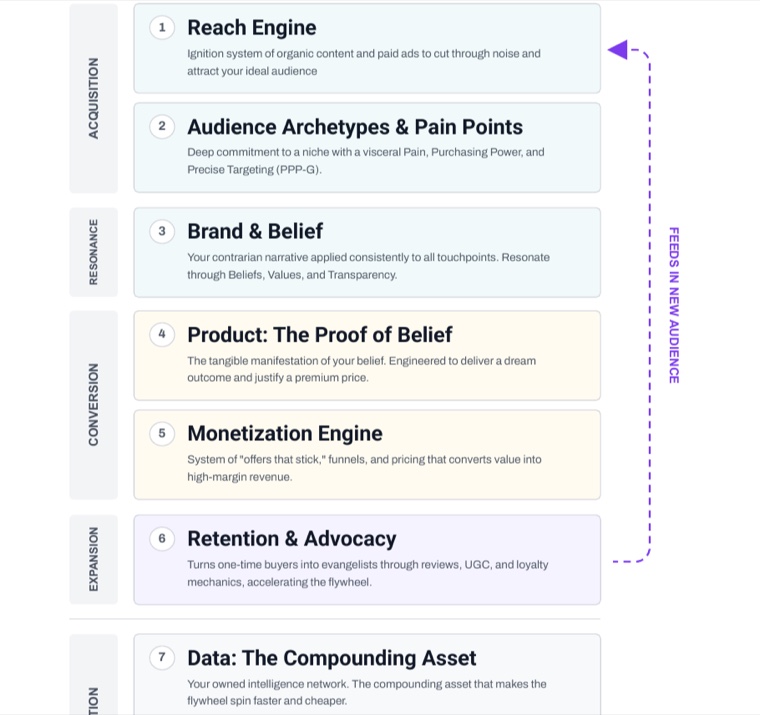
The framework stacks the layers a business can own. Reach and audience sit at the top. Belief is the reason customers choose you, and the product is the proof of it. An engine of offers and pricing turns that belief into margin. Customer data sits underneath and makes each round of growth faster and cheaper.
Using it produces two lists. The first names the layers you already own, the second the layers your growth plan depends on. Where the lists differ, build the missing layer before you spend on growth. Spend on layers you own compounds, and spend that depends on a layer you never built leaks. For the manufacturer, that means a way to capture the demand and its own customer data before the next campaign.
What's inside
- Reach engine: organic and paid ignition
- Audience archetypes and visceral pain points
- Brand and belief, applied consistently
- Product as the proof of belief
- Monetization engine of offers that stick
Scope
Where it applies, and where it does not
Operators with a solid product and real ambition use it to decide where the next euro of growth goes. The framework structures that decision, and running ads or writing content comes after it. A company still looking for its first product-market fit should sharpen the offer first.
OriginIt started as a teardown of a billion-dollar celebrity skincare exit. We generalized it for operators with good businesses and larger ambitions.
SourcesCNBC, e.l.f. Beauty to acquire Rhode (May 2025) · e.l.f. Beauty investor release