The context
Most strategy is written for a stable decade and then executed in a market that reorders itself in quarters. The pace is not a feeling. Economists found that generative AI spread faster than the personal computer or the internet at the same stage. It reached roughly two in five working-age Americans within about two years of its consumer launch. When a general-purpose technology arrives that quickly, the ground shifts while the plan is still being run.
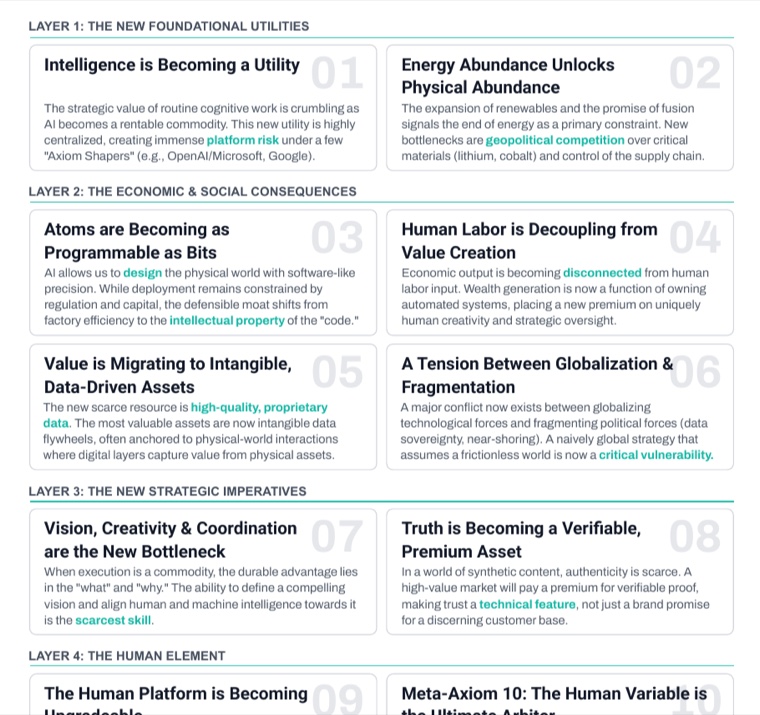
The shift that matters most is that intelligence is becoming a rentable utility. Routine cognitive work used to sit behind a competitive edge. Now it is turning into something you buy by the unit. That moves advantage away from execution, which is becoming abundant, and toward harder things: knowing what to build, coordinating people and machines, and proving what is true.
The model
The framework groups ten shifts in four layers, and writes each as a decision rule rather than a prediction. Intelligence becomes a rentable utility, so routine cognitive work stops being a moat. Energy and manufacturing move toward abundance, and value migrates to intangible, data-driven assets. Execution turns into a commodity, which moves the durable advantage to vision, coordination, and verifiable trust.
A tenth axiom holds the frame: the human variable stays the ultimate arbiter, since regulation, backlash, and the search for meaning govern how far the rest runs. Each axiom names where abundance replaces scarcity, what compounds, and what is no longer worth defending. It is a lens for deciding, not a roadmap.
What's inside
- Ten axioms in layered sequence
- Intelligence as a rentable utility
- Platform risk under the Axiom Shapers
- Value migration to intangible assets
Scope
Where it applies, and where it does not
It fits leaders setting direction under real uncertainty, deciding what to build and what to stop defending. It will not tell you which system to build tomorrow, and read on its own it stays abstract. Its value shows when the shifts are turned into specific bets, which is where the rest of the library picks up.
OriginIt is the macro research behind our own bets on AI-powered operations.
SourcesBick, Blandin, Deming — The Rapid Adoption of Generative AI (NBER w32966)