The context
Getting a product live has never been faster, and the speed hides a cost. No-code and low-code platforms can put a prototype in front of users in days. They also tend to keep the product on the platform's own infrastructure, which turns into two problems as it grows. The first is rent. Moving a prototype to production usually starts a monthly bill for servers and databases, and that bill runs whether anyone is using the app or not. This protocol calls it the idle tax. It puts the figure at roughly thirty to two hundred dollars a month before the first real user.
The second is ownership. The platforms with the strongest convenience often carry the strongest lock-in, and leaving later can mean a full rebuild. Speed and ownership usually trade against each other, and many teams end up giving up both. The question worth asking early is simple. When this works, do you own what you built?
The model
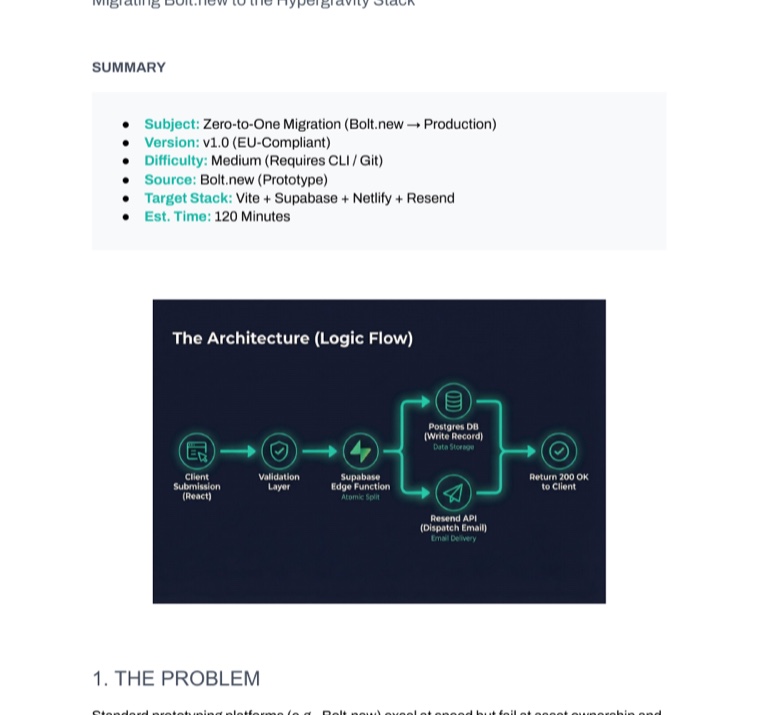
The protocol is a fixed sequence of proven components, chosen for how fast they go live rather than raw power. Get a real thing into production fast, on infrastructure you own, then validate on real usage before hardening. The reference stack pairs a static front end with serverless functions and a managed database. There is no server to rent while nobody is using it. You pay for execution, not for uptime.
Ownership is built in. The code and the data are yours. There is no platform to migrate off later. Speed comes first, and sophistication follows when traction pays for it. The result is live but load-bearing, not a demo that impresses and then stalls.
What's inside
- The idle-tax problem, quantified
- Target architecture and logic flow
- Step-by-step CLI migration
- EU data-compliance configuration
Scope
Where it applies, and where it does not
Best suited are new builds from scratch and MVPs, where launch speed and ownership both matter. As a deployment path, it will not carry a system with high scale and strict compliance needs on day one. For a large organization with an established platform and security regime, the shortcuts are the wrong trade. Speed is the point: it fits best when validating beats hardening.
OriginBehind it are our own venture builds, including the decision to cancel the subscription tool this protocol replaced.