The context
The standard responses to weak leads are well understood. Direct-response practice rests on a simple tension: anything that raises lead quality also lowers the number of leads. Tighter targeting reaches fewer people at a higher auction price. More form fields filter for intent and lose the casual majority. A harder ask, like a booked call instead of a free download, selects for commitment and thins the pipeline. Each lever works, and each is paid for in the same currency.
The blind spot is the number the decision runs on. Most teams know their cost per lead to the cent, because the ad platform reports it. Far fewer know what a lead returns by day 15, 30, or 60. That number lives in a report most companies have not built. So the reflex is to chase a lower cost per lead, which buys leads that are cheap to get and hard to close. Sometimes more volume is the right answer, not better filtering.
The model
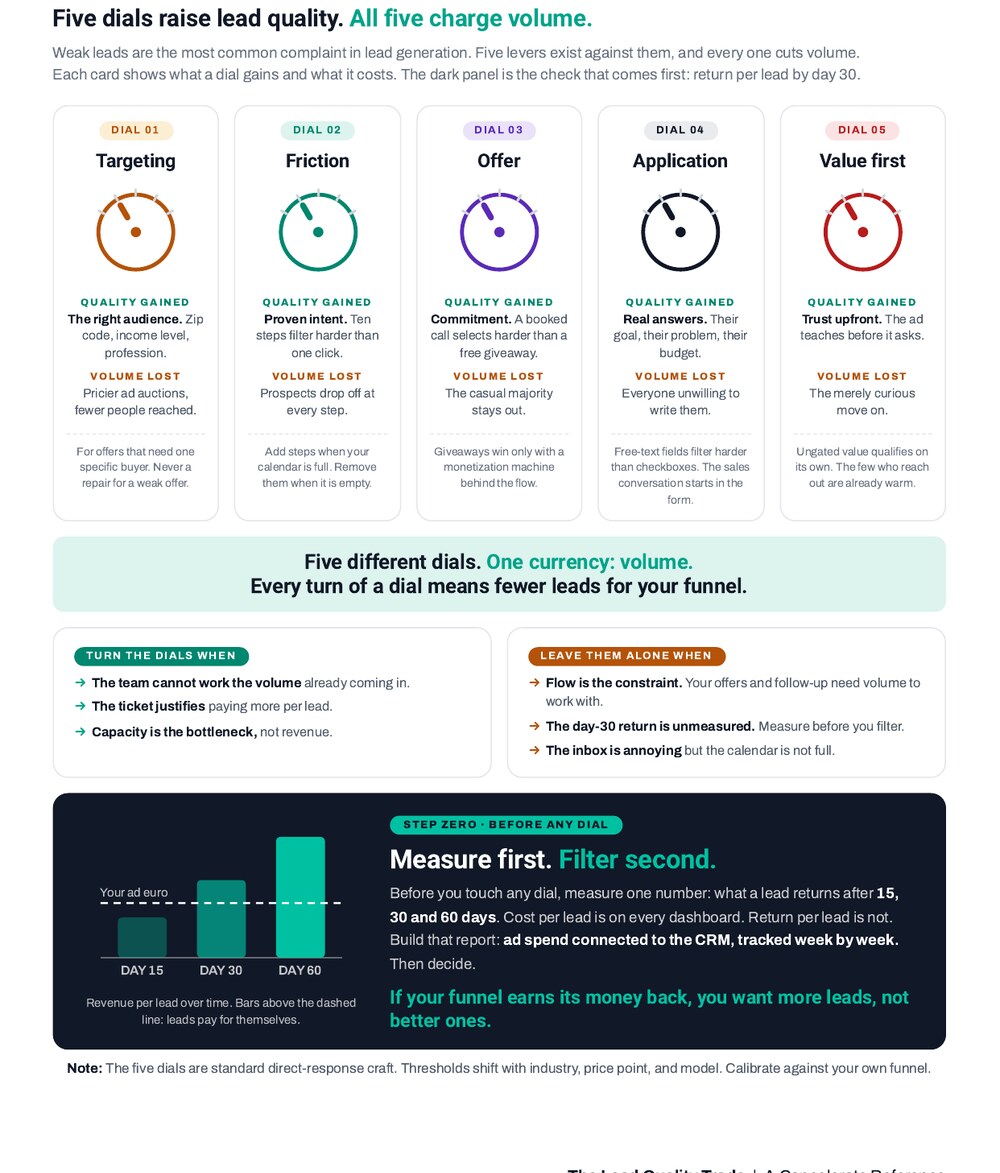
The framework starts with step zero, before any filter. Measure one number: the return per lead after 15, 30, and 60 days. Cost per lead already sits on the dashboard. Return per lead does not, so you build the report: ad spend joined to the CRM, tracked week by week. If the funnel earns its money back, you want more leads, not better ones.
Then come the five dials, and each raises quality at the cost of volume. Targeting narrows the audience. Friction adds steps that prove intent. The offer asks for commitment instead of a giveaway. The application asks for real answers in the buyer's own words. Value first teaches before it asks. Turn the dials when capacity is the bottleneck and the ticket justifies paying more per lead. Leave them alone when flow is the constraint, or when the day-30 return is still unmeasured.
What's inside
- Step zero: return per lead by day 15, 30, 60
- The five dials, quality gained against volume lost
- When to turn a dial, and when to leave it
- The report to build: ad spend joined to the CRM
- Why cheaper leads are often the wrong target
Scope
Where it applies, and where it does not
The framework is for businesses that run paid lead generation into a sales process and doubt their lead quality. It is most useful before you touch a filter: it names the number to check first. A funnel with no follow-up process, or one too new for a day-30 read, gives it nothing to measure. It will not write your ads or design your offer. When the honest problem is the model behind the funnel, no dial fixes it. The diagnosis then has to go there instead.
OriginA client asked what to fix first in their lead funnel: ads, landing page, or offer. The answer was that those are one system, not three. The five dials are standard direct-response craft, sharpened by the measure-first rule.