The context
For manufacturers and distributors of capital equipment, the one-time sale is the visible number. Yet the aftermarket is often larger and richer. McKinsey's analysis across industries puts service and parts near a 25 percent operating margin. New equipment earns about 10 percent. Over an asset's life, the aftermarket can be several times the original sale. A parallel shift the industry calls servitization has spread. Hilti rents tools with guaranteed availability, and Kaeser sells compressed air rather than compressors.
In a smaller business, this revenue stays invisible. Service on machines already in the field is often handled as a favor and never priced, and a monthly rate is rarely offered, even though many buyers would prefer it. For them, a rental turns a large purchase into a small operating cost. Recurring income also reads differently to a bank than a warehouse of stock. This does not fit all products. It fits the ones bought rarely, used often, and expensive enough that ownership is a burden.
The model
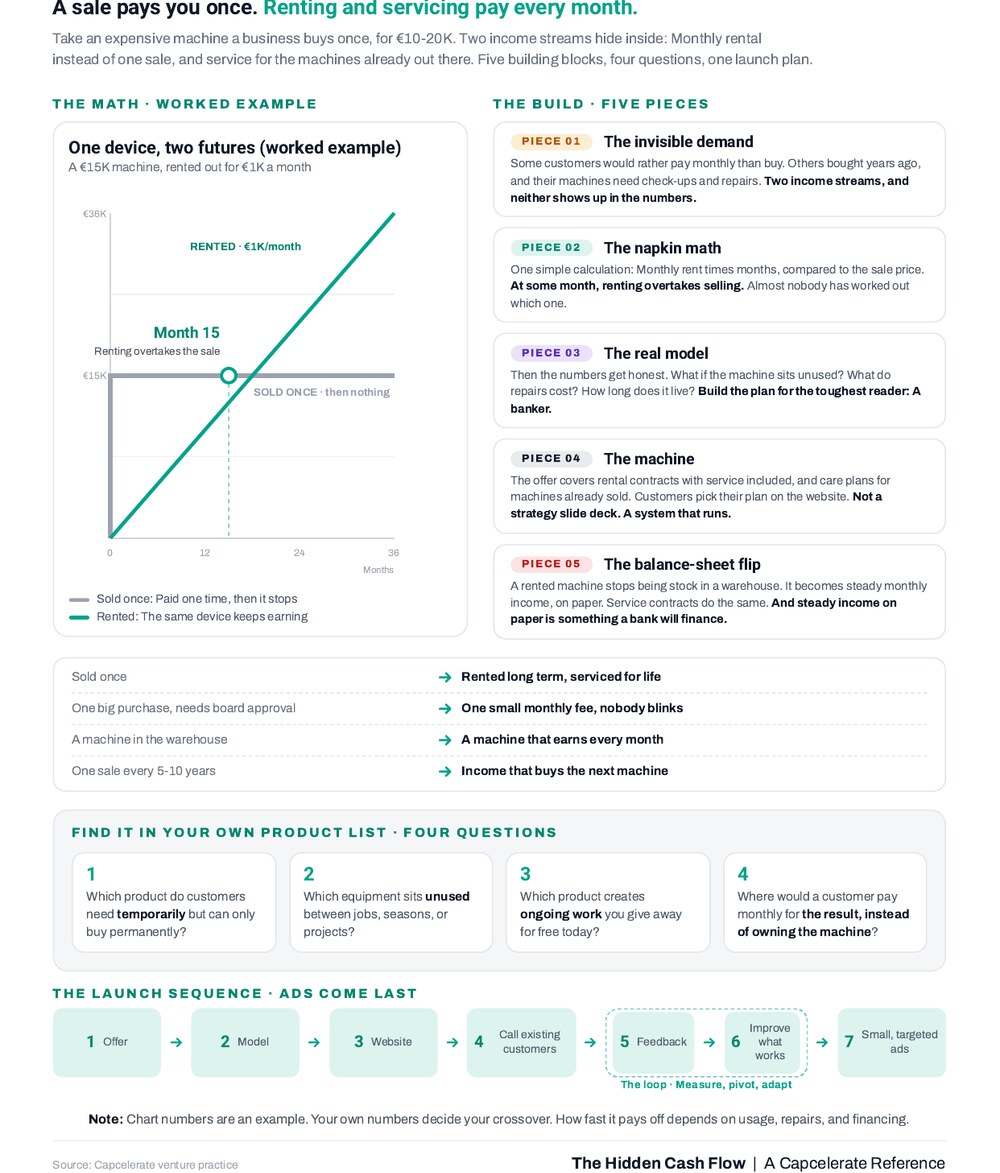
The framework moves in five pieces. First, the invisible demand: the customers who would rather rent, and the installed base that needs service nobody sells. Second, the napkin math sets monthly rent times the months against the sale price, until renting overtakes selling. The framework's worked example rents a €15,000 machine at €1,000 a month. There, the rental total passes the sale around month 15. Third, the real model is honest about idle machines, repair costs, and lifespan. It has to survive the toughest reader, a banker.
Fourth, the machine itself: rental contracts with service included, care plans for machines already sold, bookable on the website. Fifth, the balance-sheet flip. A rented machine stops being stock in a warehouse and becomes steady monthly income, which a bank will finance. The launch sequence puts ads last: offer, model, website, then a call to existing customers, then feedback and tuning. Only then come small, targeted ads.
What's inside
- Two hidden streams: rental and installed-base service
- The crossover math, sale price against monthly rent
- The banker-ready model: idle time, repairs, lifespan
- Four questions to find it in your product list
- The launch sequence, with ads last
Scope
Where it applies, and where it does not
It fits businesses that sell expensive equipment rarely, where the same machine could be rented and the installed base serviced. It suits products used continuously and costly enough that owning them is a burden. It does not fit low-price or fast-moving goods. There is nothing to rent there, and no aftermarket to price. Changing the revenue model takes longer than a campaign, and it needs the capital to hold assets on the books. Where a product is bought once and forgotten, there is usually nothing hidden to find.
OriginIt comes from a rental and service line we built for a client, told here at the pattern level.
SourcesMcKinsey, Industrial aftermarket services: growing the core