The context
A growing store can be profitable on paper and still run out of cash. The reason is timing. You pay for inventory weeks or months before it sells, payment processors hold settled funds for days, and marketplace payouts add another lag. The gap between paying suppliers and collecting from customers is the cash conversion cycle, and it widens just when sales accelerate. This is why founders watch a healthy P&L and an empty bank account at the same time.
Faster growth needs more inventory, and more inventory needs more cash committed further ahead, an effect that gets severe on long lead times. The money is still there, trapped in stock, in transit, or waiting to be paid out. Revenue and margin describe whether the business works. They say nothing about whether it can meet a supplier invoice on the day it is due.
The model
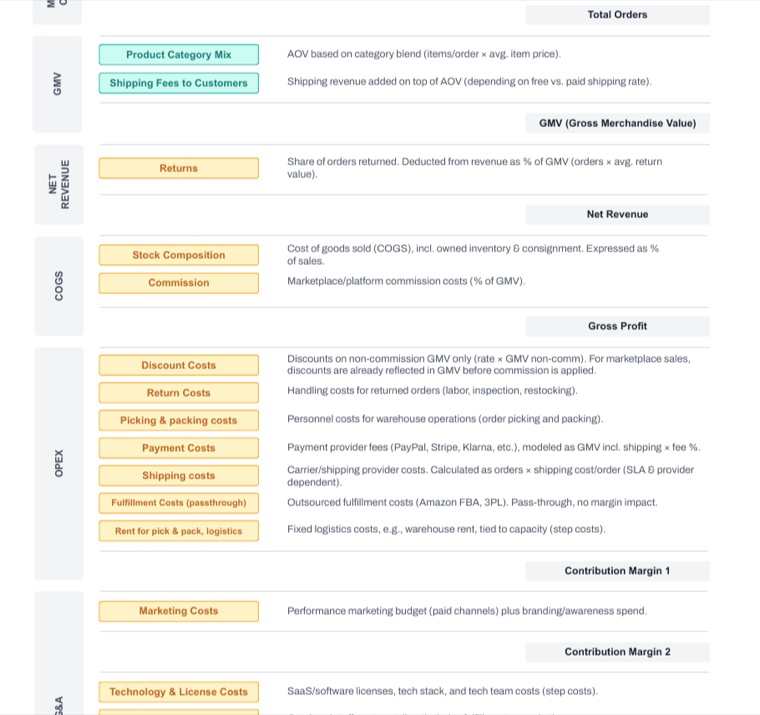
The model traces one chain from end to end. Marketing spend becomes demand, demand becomes orders, orders become fulfillment, and fulfillment becomes a payout. At each link the model carries the working-capital math and the real cost stack. That stack holds commissions, returns, picking and packing, payment fees, and shipping. It separates contribution margin from gross profit, so you see what each order keeps.
The lesson lands in the timing. At €250K a month on FBA with 90-day lead times, roughly €695K sits trapped at any moment, in inventory, in transit, or waiting on a payout. Margin tells you whether you are profitable. The chain tells you whether you can pay the supplier on Thursday.
What's inside
- Paid channels modeled via blended CPO
- Retention modeled via cohort repurchase
- GMV build-up: mix, AOV, shipping
- Returns and net revenue mechanics
- COGS and stock composition
Scope
Where it applies, and where it does not
Use it wherever inventory is bought ahead of sale and payouts arrive later, especially on long lead times. It models cash and unit economics and shows where cash gets stuck. Demand, pricing and how to sell more are separate questions. For a pure services business with no inventory, the working-capital math mostly disappears, and the model has little to add.
OriginIt grew out of six years of transaction data turned into a working P&L. Its other root is the cash question that scaling clients eventually ask.