The context
Scaling an e-commerce business is usually framed as a traffic problem, where more spend means more growth. The uncomfortable part is that paid traffic amplifies whatever it hits. If the shop converts poorly or returns run high, more budget multiplies the loss instead of the revenue. A conversion rate in the low single digits is normal, and in some categories return rates run above thirty percent. Neither averages out at volume. They compound.
So the order of operations matters more than the ambition. The structure underneath growth has to hold before the paid layer is worth switching on. That covers the storefront and fulfillment, the daily operations, and the cash to finance inventory. Most plans skip working capital, because it sits with the factory and the bank rather than the marketing team. The most expensive way to learn a shop is broken is to pour paid traffic into it.
The model
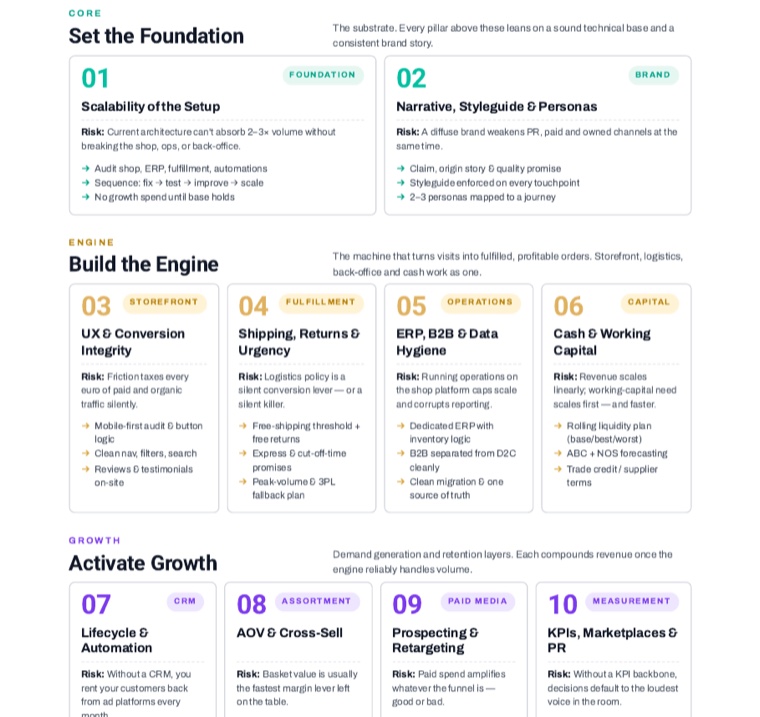
The model has ten pillars in three tiers. Core sets the foundation: a scalable setup and a consistent brand. Engine turns visits into fulfilled, profitable orders, and covers storefront, fulfillment, operations, and working capital. Growth activates demand and retention through CRM, assortment, paid media, and measurement. Each tier compounds only when the one below it holds. Most businesses fail at the Engine tier, while many growth plans start at the Growth tier.
The pillar missing from most growth plans is capital. Going from €400K to €3M means pre-financing roughly €1M of inventory. That money goes out before the first new euro of revenue arrives. The matrix names the structural risk in each pillar and the first three actions that usually address it.
What's inside
- Ten pillars from foundation to brand
- The structural risk behind each pillar
- First three unlock actions per pillar
- Working capital as an operations pillar
- One A4 page, built for print
Scope
Where it applies, and where it does not
It fits a working e-commerce business that is trying to scale and keeps stalling, usually somewhere between roughly €400K and €3M. The result is a diagnosis of which pillar gives way first. It does not pick the next ad or the next market. For a pre-revenue launch, most pillars have nothing to stand on yet. When the constraint is demand rather than structure, a market-entry lens fits better.
OriginIt generalizes the scale-up brief of a €400K business with a €3M ambition.